

Can You Go to Jail for Violating an Order of Protection in New York?
Yes, you can go to jail for violating an order of protection in New York. The offense is charged as criminal contempt, which carries penalties ranging from a Class A misdemeanor to a Class D felony depending on the specific conduct and prior history. Garbett Law Office in New City helps clients navigate these serious charges with immediate legal counsel.
Understanding Criminal Contempt in New York
New York law treats the violation of a court order as a distinct criminal offense known as criminal contempt. Criminal contempt is the intentional disobedience of a valid court order, such as an order of protection. This charge is governed by New York Penal Law Article 215. The severity of the charge depends on the nature of the violation and the defendant's history.
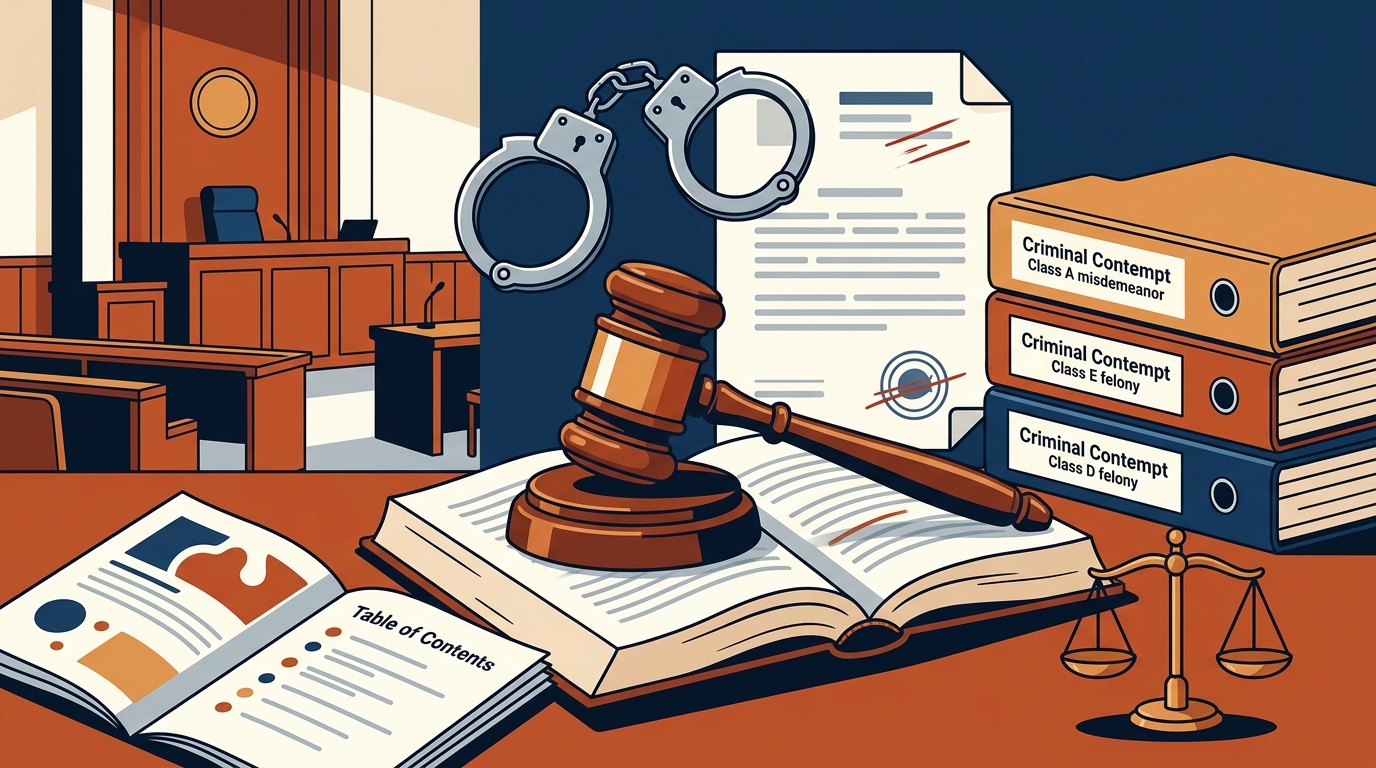
The most common charge for a first-time violation is Criminal Contempt in the Second Degree under Section 215.50. This is a Class A misdemeanor that carries a maximum penalty of one year in jail. However, the law escalates the charge to Criminal Contempt in the First Degree under Section 215.51 if the violation involves following, telephoning, or appearing within sight of the protected person. This is a Class E felony, which can result in up to four years in state prison.
For the most severe cases, the law provides for Aggravated Criminal Contempt under Section 215.52. This charge applies when the violation causes physical injury or places the protected person in reasonable fear of physical injury. It is classified as a Class D felony, carrying a maximum sentence of seven years in prison. Understanding these distinctions is critical because the potential jail time varies significantly based on the specific facts of the case.
The Invited Contact Defense and Its Limits
A common misconception is that if the protected party initiates contact, the restrained party cannot be arrested. In reality, New York law places the obligation entirely on the restrained party to avoid all contact. This means that even if the other person calls, texts, or shows up at your home, responding to that contact can still result in an arrest for criminal contempt.
While the fact that the protected party initiated contact is not a complete legal defense, it is a highly relevant fact in the case. It can affect the credibility of the alleged violation and the intent of the defendant. For example, if a defendant responds to a text message initiated by the protected party, that context may influence the court's decision on sentencing or the modification of the order. However, it does not automatically dismiss the charge. The police are required to arrest if there is reasonable cause to believe the order was violated, regardless of who started the interaction.
At Garbett Law Office, we often see clients who are shocked by an arrest after responding to a call from the protected party. It is essential to understand that the law is strict on this point. The defense strategy in these cases often focuses on demonstrating a lack of intent to harass or annoy, or on seeking to modify the order to reflect the new reality of the relationship.
Penalty Structures and Sentencing Outcomes
The potential penalties for violating an order of protection in New York are structured by the degree of the criminal contempt charge. For a Class A misdemeanor (Second Degree), the maximum jail sentence is one year. In practice, first-time offenders may receive probation or a fine, but jail time is a real possibility, especially if there are prior violations or if the conduct was threatening.
For a Class E felony (First Degree), the maximum sentence is four years in state prison. This charge is often applied when the defendant violates the order by following the protected person or making threatening contact. A Class D felony (Aggravated Criminal Contempt) carries a maximum of seven years in prison. This is the most serious charge and is reserved for cases involving physical injury or a reasonable fear of injury.
It is important to note that a violation does not automatically mean you will go to prison. Violation hearings are not full criminal trials; the standard of proof is lower, and hearsay evidence is generally admissible. However, the consequences are real. Having experienced legal representation at your violation hearing makes a significant difference in the outcome. The judge has the discretion to continue probation with modified conditions, extend the probation period, or impose a jail or prison sentence up to the maximum of the original charge.
Immediate Steps After an Arrest
If you have been arrested for violating an order of protection, the first step is to remain silent and request an attorney. Do not attempt to explain your side of the story to the police or the protected party. Any statement you make can be used against you in the violation hearing. The police will likely file a violation report, and you will be summoned to appear or arrested for the contempt charge.
Speed matters in these cases. The sooner you have legal representation, the better your chances of influencing the outcome. An attorney can review the evidence, challenge the credibility of the alleged violation, and present mitigating circumstances. For example, if the violation was accidental or if the protected party initiated the contact, an attorney can argue for a lesser charge or a more lenient sentence. Garbett Law Office is available 24/7 to provide immediate legal counsel for clients facing these charges.
It is also important to understand that the criminal case and any family court proceedings are separate but related. A violation of an order of protection can affect your custody and visitation rights. An experienced attorney can manage both sides of the situation coherently, ensuring that your rights are protected in all forums.
Key Takeaways
- Violating an order of protection in New York is charged as criminal contempt, which can result in jail time.
- Criminal Contempt in the Second Degree is a Class A misdemeanor with a maximum of one year in jail.
- Criminal Contempt in the First Degree is a Class E felony with a maximum of four years in prison.
- Aggravated Criminal Contempt is a Class D felony with a maximum of seven years in prison.
- Responding to contact initiated by the protected party is not a complete legal defense.
- Violation hearings have a lower standard of proof than criminal trials, and hearsay is admissible.
- Immediate legal representation is critical to challenging the evidence and presenting mitigating circumstances.
Frequently Asked Questions
What is the maximum jail time for a first-time violation of an order of protection?
For a first-time violation charged as Criminal Contempt in the Second Degree, the maximum jail time is one year. If the violation involves following or threatening contact, it may be charged as a Class E felony, carrying up to four years in prison.
Can I be arrested if the protected party called me first?
Yes, you can be arrested. New York law places the obligation on the restrained party to avoid all contact, regardless of who initiates it. However, the fact that the protected party initiated contact is a relevant fact that can affect the outcome of the case.
What is the difference between a misdemeanor and a felony violation?
A misdemeanor violation (Second Degree) involves intentionally disobeying the order and carries up to one year in jail. A felony violation (First or Aggravated Degree) involves more serious conduct, such as following, threatening, or causing injury, and carries up to four or seven years in prison, respectively.
Does a violation of an order of protection go on my criminal record?
Yes, a conviction for criminal contempt is a criminal offense and will appear on your criminal record. This can have long-term consequences for your employment, housing, and professional licenses.
Can the protected party drop the charges?
Once an arrest is made, the case is in the hands of the District Attorney's Office. The protected party cannot unilaterally drop the charges, although their cooperation or lack thereof can influence the prosecution's decision.
What should I do if I am arrested for violating an order of protection?
Remain silent, request an attorney, and do not contact the protected party. Contact a criminal defense attorney immediately to discuss your case and develop a defense strategy.
How does a violation affect my custody rights?
A violation of an order of protection can negatively impact your custody and visitation rights in family court. It is important to have an attorney who can manage both the criminal and family law aspects of your case.
Conclusion
Violating an order of protection in New York is a serious criminal offense that can result in significant jail time. The charge is classified as criminal contempt, with penalties ranging from a Class A misdemeanor to a Class D felony depending on the specific conduct and prior history. It is crucial to understand that responding to contact initiated by the protected party is not a complete legal defense. If you have been arrested for violating an order of protection, it is essential to seek immediate legal counsel. Garbett Law Office in New City provides experienced representation for clients facing these charges in Rockland and Orange County. Call us today for a confidential consultation.