

Order of Protection Violation Consequences in New York: The 2026 Guide
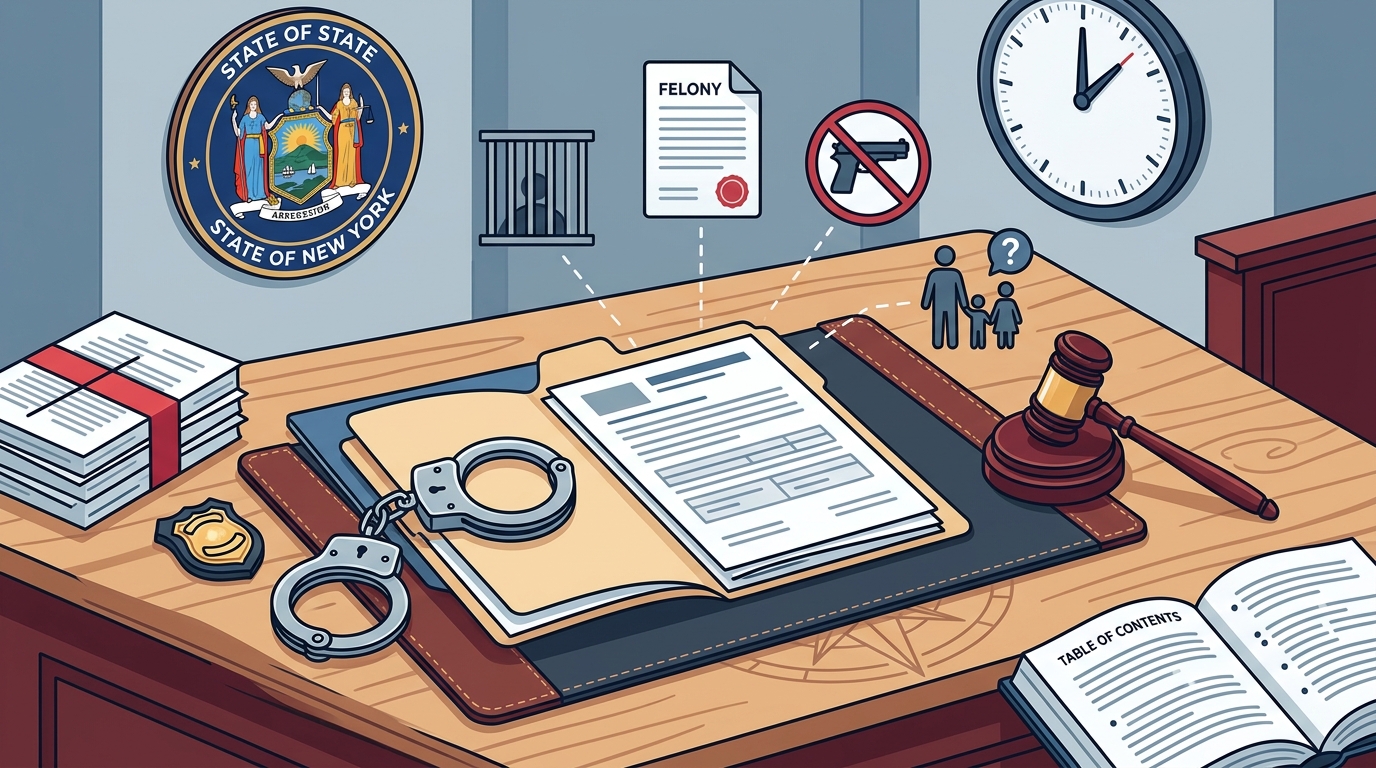
Violating an order of protection in New York is a crime that triggers immediate police action and serious legal penalties. The consequences range from misdemeanor jail time to felony charges, depending on the specific conduct and prior history. This guide explains the criminal contempt statutes, mandatory arrest rules, and the collateral impacts on firearms and child custody that you must understand immediately.
Criminal Contempt Charges
In New York, violating an order of protection is not charged as a standalone offense but as Criminal Contempt. Criminal Contempt is the intentional disobedience of a valid court order. The severity of the charge depends on the nature of the violation and the defendant's prior record. Understanding the specific degree of contempt is critical because it dictates the potential jail time and whether the case is treated as a misdemeanor or a felony.
Second Degree Criminal Contempt
Second Degree Criminal Contempt is a Class A misdemeanor under New York Penal Law Section 215.50. It applies when a person intentionally disobeys a court order. The maximum penalty is one year in jail. Most first-time violations of an order of protection are charged at this level. The prosecution must prove that you knew the order existed and that you intentionally violated it. Negligence or accidental contact may still be charged, but intent is a key element the defense will scrutinize.
First Degree Criminal Contempt
First Degree Criminal Contempt is a Class E felony under Section 215.51. This charge applies in more serious scenarios, such as when the violation involves following, telephoning, or appearing within sight of the protected person. It also applies if the violation was committed with the intent to harass, annoy, or alarm, particularly if there is a prior finding of criminal contempt. A Class E felony carries a maximum sentence of four years in state prison. This elevation significantly increases the stakes of the case.
Aggravated Criminal Contempt
Aggravated Criminal Contempt is a Class D felony under Section 215.52. This is the most severe charge for an order of protection violation. It applies when the violation results in physical injury to the protected person or places them in reasonable fear of physical injury. A Class D felony carries a maximum sentence of seven years in state prison. If physical contact occurred, the prosecution will likely pursue this charge, making immediate legal intervention essential.
Mandatory Arrest Procedures
New York enforces strict mandatory arrest policies in domestic violence and order of protection cases. Police officers are required to make an arrest if they have reasonable cause to believe a violation has occurred. This means that even if the protected party does not want you arrested, the officer may still be legally obligated to take you into custody. The system is designed to protect the victim, but it leaves the accused with very little control over the immediate outcome.
The Role of Police Discretion
While the arrest is mandatory, the charging decision rests with the District Attorney's Office. However, the initial arrest triggers a chain of events that is difficult to stop. You will be processed, fingerprinted, and photographed. A temporary order of protection may be issued at your arraignment, which can further restrict your movements and contact with the protected party. The speed of this process means that having an attorney ready to act before your first court appearance is crucial.
Reporting Violations
It is a crime to violate a temporary or final order of protection, and victims are encouraged to report violations to the police immediately. New York Courts confirm that if the respondent does not obey the order, the protected party can call the police. This reporting mechanism ensures that violations are documented and acted upon quickly. For the accused, this means that any contact, even if initiated by the other party, can lead to an arrest if reported.
Firearms Restrictions
Violating an order of protection has immediate and severe consequences for your right to possess firearms. New York law imposes strict restrictions on individuals who have been convicted of certain offenses or who are subject to certain court orders. If you are charged with or convicted of a crime of domestic violence or a violation of an order of protection, you may be prohibited from possessing or purchasing firearms.
Immediate Surrender Requirements
In many cases, a temporary order of protection issued at arraignment will include a provision requiring the surrender of any firearms in your possession. You may be required to turn over your weapons to law enforcement or a licensed dealer for safekeeping. Failure to comply with this requirement can result in additional criminal charges. The loss of firearm possession is a significant collateral consequence that affects both personal safety and legal rights.
Long-Term Prohibitions
A conviction for a crime of domestic violence or a violation of an order of protection can lead to a permanent or long-term prohibition on firearm possession. This restriction is separate from any criminal sentence and can last for years or even a lifetime, depending on the specific charges and the court's ruling. Understanding these restrictions is vital for anyone who owns firearms. Consulting with a criminal defense attorney can help you navigate the legal requirements for surrendering or retaining your weapons in compliance with the law.
Custody Impact
Family law and criminal law intersect significantly in cases involving orders of protection. A violation of an order of protection can have a profound impact on child custody and visitation rights. Courts prioritize the safety and well-being of children, and a criminal charge for violating a protective order is viewed as a serious indicator of risk. This can lead to the suspension or modification of your custody and visitation arrangements.
Best Interests of the Child
New York courts apply the "best interests of the child" standard in all custody determinations. A violation of an order of protection is a factor that courts consider when evaluating a parent's fitness and ability to provide a safe environment. Even if the violation is minor, the fact that you disobeyed a court order can be used against you in a custody proceeding. The court may order supervised visitation or reduce your parenting time to ensure the child's safety.
Coordinated Legal Strategy
Managing both the criminal case and the family law case requires a coordinated legal strategy. An attorney who understands both areas of law can work to protect your rights in the criminal proceeding while advocating for your parental rights in family court. Failing to address the custody implications of a criminal charge can result in long-term damage to your relationship with your children. It is essential to have a legal team that can handle both sides of the situation effectively.
Key Takeaways
- Violating an order of protection in New York is charged as Criminal Contempt, which can be a misdemeanor or a felony.
- Second Degree Criminal Contempt is a Class A misdemeanor with a maximum of one year in jail.
- First Degree Criminal Contempt is a Class E felony with a maximum of four years in prison.
- Aggravated Criminal Contempt is a Class D felony with a maximum of seven years in prison.
- Police are required to make an arrest if they have reasonable cause to believe a violation occurred.
- Violations can lead to immediate and long-term restrictions on firearm possession.
- Custody and visitation rights can be suspended or modified due to a violation of an order of protection.
- Immediate legal representation is critical to navigating the criminal and family law consequences.
Frequently Asked Questions
What is the maximum jail time for violating an order of protection?
The maximum jail time depends on the degree of the charge. Second Degree Criminal Contempt carries a maximum of one year. First Degree Criminal Contempt carries a maximum of four years. Aggravated Criminal Contempt carries a maximum of seven years.
Can I be arrested if the other party initiated the contact?
Yes. New York law places the obligation on the restrained party to avoid all contact. Even if the protected party initiated the contact, you can still be arrested for responding to it.
Does a violation of an order of protection go on my criminal record?
Yes. A conviction for Criminal Contempt is a criminal offense and will appear on your criminal record. This can have long-term consequences for employment, housing, and professional licenses.
How does a violation affect my child custody case?
A violation can negatively impact your custody case. Courts consider the safety of the child, and a violation of a protective order is a factor that can lead to reduced visitation or supervised custody.
Do I have to surrender my firearms if I am charged?
Often, yes. A temporary order of protection may require you to surrender your firearms. You should consult with an attorney to understand your specific obligations and rights regarding your weapons.
What should I do immediately after being arrested?
Do not speak to the police without an attorney present. Contact a criminal defense lawyer immediately to discuss your case and protect your rights. The first steps you take can significantly impact the outcome of your case.
Conclusion
Violating an order of protection in New York is a serious legal matter with far-reaching consequences. From criminal contempt charges to mandatory arrest and restrictions on firearms and custody, the impact of a violation can alter your life significantly. At Garbett Law Office, we understand the complexities of these cases and the importance of immediate, strategic defense. Our firm is dedicated to protecting your rights and helping you navigate the legal system with confidence. If you are facing a charge for violating an order of protection, do not wait. Contact us today for a confidential consultation and take the first step toward protecting your future.